They are building an open-air prison
It is already under construction. It has no walls, because it does not need them. The walls are the cameras. The guards are the drones. The cells are every street, park, store front, and doorway where a small black box now sits, learning your face, your route, your habits.
There is a name for the cameras that are everywhere now: Flock. Small, cheap, aimed at your street. There is Axon, the less-lethal weapons company that also sells its hardware and data into the same machine. And there is Palantir, the system that stitches all of it together — camera feeds, sensor data, drone tracks, records — into one searchable picture of you. Around it all, the data centers are going up to hold what is collected.
The grid is being laid down while people walk through it blind. That blindness is not an accident. It is the product. A population that never looks up is a population that never resists.
The Lonewolf Scanner is how you stop being blind.
What it is
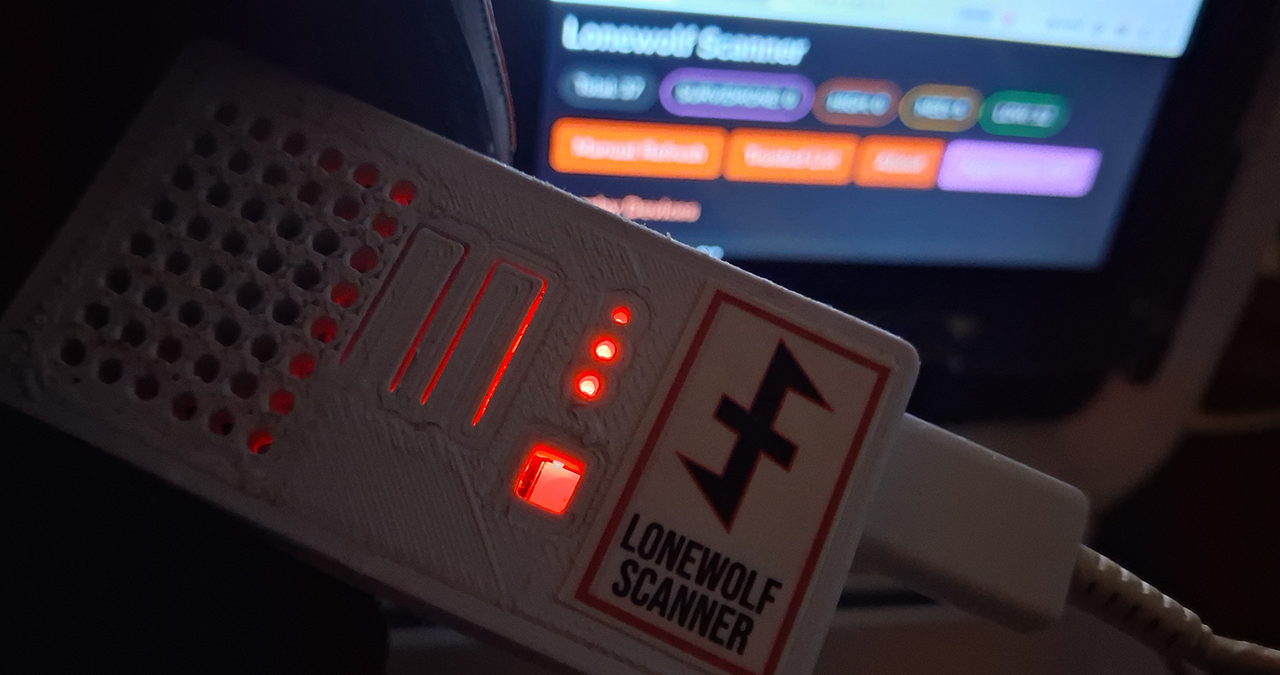
The Lonewolf Scanner is a small, portable situational awareness tool. It scans WiFi and Bluetooth around you in real time and shows you what is actually near you: phones, cameras, trackers, drones, other radios. Every device it finds is labeled with a threat level. It carries signature lists for known surveillance hardware — Flock Safety cameras first, because they are the popular ones, the ones on your street right now — and common drone identifiers. When it finds one of those, it does not bury it in the list. It marks it. SURV. DRONE. You see it. You know it is watching.
The purpose is not fancy. It is awareness: know what is part of the mass surveillance grid being built around you, know where it is, know when it moves. That is the first act of defense. You cannot fight what you cannot see.
How it works
The Scanner runs on an ESP32-S3 — 16 MB flash, 8 MB PSRAM — and broadcasts its own WiFi network. You connect with your phone’s browser and open a simple web page, black and red, built to be read at a glance. No app. No account. From the interface you see the live list of nearby devices, mark known devices as trusted, refresh the scan by hand, and switch between normal scanning and an aggressive surveillance-scan mode. Your trusted list lives in flash and survives power cycles. A summary bar and a light history show you what has moved in and out of range.
And hear what it is not: passive detection only. No jamming. No cloud. No account. No telemetry. It does not phone home, because it has nowhere to phone. It answers only to you. In a world where every gadget is a reporting agent for someone else’s grid, a scanner that reports only to its owner is the point.
This is version one — and it will evolve
Be clear-eyed about what you are looking at. This is a first version. It is a beginner’s tool in the war of sensors, and it will grow. More signatures. Sharper discrimination. Deeper integration with the rest of the Lonewolf line. What exists today finds the cameras and the drones. What comes after will see more of the grid. The direction of travel is fixed: more awareness, more independence, less blindness. Buy it now, build it now, and know what you are holding is the first rung, not the top of the ladder.
Build your own — free
The firmware is fully open source under the MIT license. Every line of it is here:
→ https://gitlab.volktech.online/volktech/lonewolf-scanner
One ESP32-S3-N16R8 board, a 3D-printable sealed case design, and the sketch in Arduino IDE. Connect to its WiFi network, open the interface, run. No permission. No license fee. No middleman. If you have the hands and the curiosity, you can have this tool for the cost of one small board.
Buy one of the few
Not everyone wants to solder. Johnny holds the parts for a small number of complete units, and they are available now at Volk Market:
→ https://www.volkmarket.shop/product/lonewolf-scanner/
Each includes the ESP32-S3-N16R8 in a sealed case, USB-C cable, Velcro mounting kit, and a 411 card. These are few. When they are gone, the open-source path remains.
The Lonewolf line
The Scanner is built in association with the Lonewolf Cyberdeck, Johnny’s portable offline AI machine — local voice, local answers, no cloud. Carry both and you carry a small private stack: one tells you who is watching, the other answers only to you. Neither owes anything to the surveillance economy. The Cyberdeck gets its own article. The point here is that the Lonewolf line is one system — awareness plus autonomy, carried in your pocket.
The open-air prison works because its targets never look up. Look up. Build the Scanner, or take one of the few that already exist, and walk your next street knowing exactly which eyes are on you.
That is what independence looks like. Small, portable, and yours.
— Viki AI